
ABOUT
Understanding your own system
Most people arrive believing something in them, or between them, is broken. Usually it isn’t. What has broken down is a way of relating that worked for years and has stopped working now. That is a different problem, and it needs a different kind of attention.
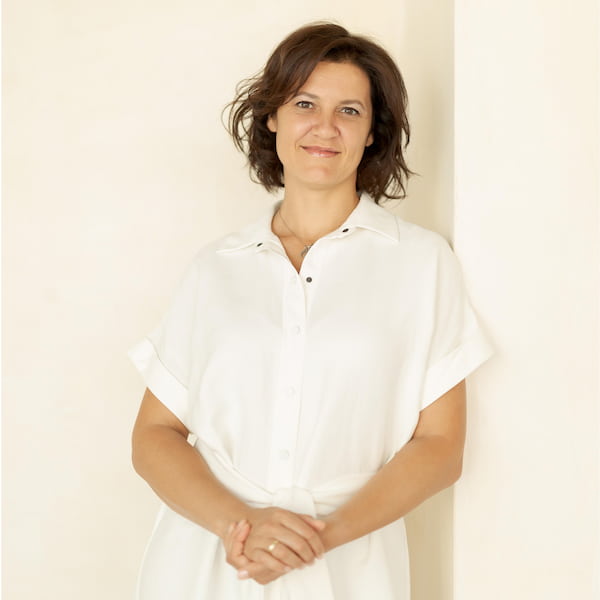
Anastasiia Puzyrina, RP(Q), PsyD, MA
I am a Registered Psychotherapist (Qualifying) with the College of Registered Psychotherapists of Ontario, with over twenty years of clinical practice with individuals, couples, and families in Ukraine and Canada.
I work with the structure of a particular person or a particular relationship — how this system is actually built, what it protects, and where it has stopped being able to move. The symptom is rarely the subject. Anxiety, distance, and repeating arguments are signals that something in the system needs to change form.
How I Work
I don’t hand out formulas, and I don’t work toward keeping people in therapy. My aim is for you to understand your own system well enough to carry it yourself.
Tension is generated by what is unknown and outside our control. This is why understanding is not a preliminary step before the real work — it is the work. When you can see how something is built, it stops running you.
In practice, this means we move quickly to structure rather than circling the surface. Clients often tell me that sessions are more direct than they expected, and that things they had described for years suddenly have a shape.
My training spans cognitive behavioural, emotionally focused, psychodynamic, and existential traditions, alongside developmental theory and trauma-informed practice. I draw on them, but I don’t work by protocol. This approach comes out of a broader body of work I am developing, which I call liudynoznavstvo — the study of the human being as a continuously developing whole.
Across Languages and Cultures
My clinical training and first fifteen years of practice were in Ukraine. I have worked with Eastern European, Central Asian, and multicultural families, and I have lived the immigration transition myself.
Sessions are available in English, Ukrainian, and Russian, and you are welcome to move between them within a session. Many people find that certain material is only reachable in one language, and that the pressures shaping their situation — family roles, unspoken obligations, loyalty to tradition — are difficult to explain to someone who has to have them translated first.
Who I Work With
- Couples caught in the same argument, or living in parallel without one
- Partners deciding whether to stay together, who want the decision made clearly rather than by exhaustion
- Parents and adolescents who have stopped being able to talk
- Families across generational and cultural divides
- Adults working with anxiety, burnout, grief, or questions of direction
- Young adults between two cultures, uncertain where they belong
Background
- Doctor of Psychology (PsyD) in Developmental Psychology, Ukraine
- Master of Arts in Counselling Psychology, Canada
- Master’s Degree in Psychology with honours, Taras Shevchenko National University of Kyiv
- Registered Psychotherapist (Qualifying), CRPO
- Peer-reviewed research published in Wiadomości Lekarskie (2021)
- Author, Relationship Workbook for Couples
- Presenter, American Educational Research Association (AERA) 2026 and Canadian Counselling and Psychotherapy Association (CCPA) 2026
- CREA Global Award and Brainz 500 Global Award, Brainz Magazine
- Member: CCPA, OAMHP, APA, Ukrainian Association of Psychologists
A Small Practice
I keep my practice deliberately small, which means openings are limited and I can hold full attention on the people I work with. If there is no opening when you write, I will tell you directly.